Books

The books behind the courses

Three practitioner books published by Spin Dynamics LLC Press. Each one is the source of a course track.

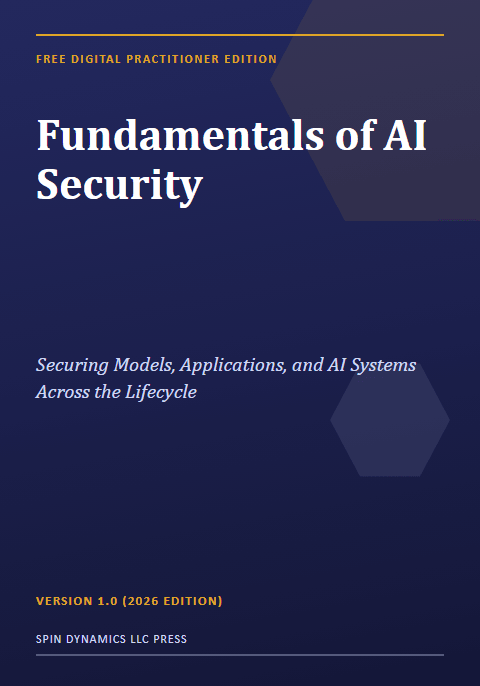
Cover of Fundamentals of AI Security

Fundamentals of AI Security

Securing Models, Applications, and AI Systems Across the Lifecycle

Practitioner textbookComing soon

A practitioner textbook developed for AISecurity.Academy. It establishes AI security as a distinct but integrated discipline: what changes when a system's behavior is learned rather than programmed, why that creates attack surfaces classical controls do not cover, and why an AI system must be secured as a whole socio-technical system rather than as a model in isolation.

Twenty-four chapters in four parts move from foundations through the AI threat landscape and defensive engineering to governance, frameworks, and workforce readiness, ending with a capstone that produces a threat model, an architecture review, a red-team exercise, and an assurance report. Every chapter carries learning objectives, and most include labs. Four appendices supply a control checklist, a risk register template, a framework crosswalk, and a lab environment guide.

Course track
AI Security Fundamentals

Written for

  • Students in cybersecurity, AI, machine learning, secure software engineering, and trustworthy AI programs at upper-undergraduate or graduate level.
  • AI and ML engineers who build models, pipelines, retrieval systems, and agents and need a security-first understanding of what they are deploying.
  • Cybersecurity practitioners, from architects and application security engineers to SOC analysts, red teamers, incident responders, and risk and governance professionals.
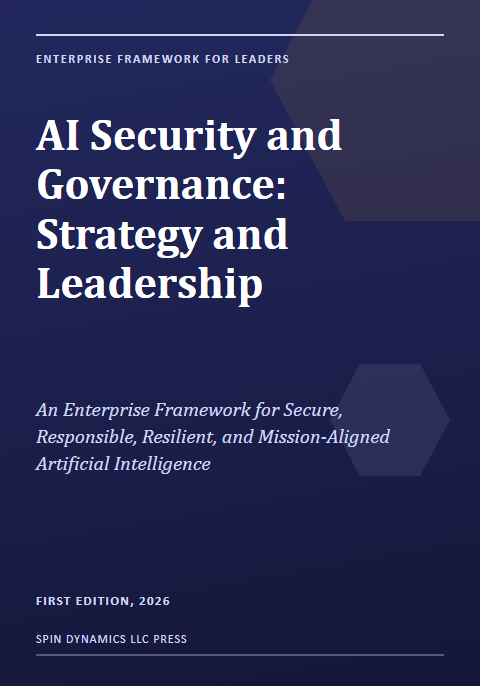
Cover of AI Security and Governance: Strategy and Leadership

AI Security and Governance: Strategy and Leadership

An Enterprise Framework for Secure, Responsible, Resilient, and Mission-Aligned Artificial Intelligence

Enterprise framework for leadersComing soon

Argues that AI security is an enterprise leadership capability that governs the complete system of people, data, models, agents, tools, infrastructure, decisions, and consequences, not a control placed around a model. Governance decides why AI is used, by whom, within what limits, and on what evidence. Security engineers make those limits real, observable, and recoverable.

Twenty-two chapters follow one operating philosophy: Discover what AI exists, Govern why and how it is used, Build secure-by-design architectures, Prove readiness through evidence, Observe operation, Respond when boundaries are crossed, and Improve continuously. Each chapter opens with an executive takeaway and works through fictional composite scenarios. Twenty-four appendices supply the working instruments: intake forms, risk-tiering worksheets, review checklists, a RACI, a threat-model template, red-team rules of engagement, incident playbooks, a vendor questionnaire, KPI and KRI catalogs, roadmaps, and policy statements.

Course track
AI Security and Governance: Strategy and Leadership

Written for

  • Executives and boards who set risk appetite, fund programs, and own outcomes.
  • CISOs, Chief AI Officers, CIOs, CTOs, and CDOs who design the operating model, and the heads of AI security who build and run the program.
  • Architects, engineers, security operations, incident responders, risk, compliance, audit, procurement, privacy, and legal leaders, and public-sector technology leaders.

All rights reserved. Published by Spin Dynamics LLC Press.

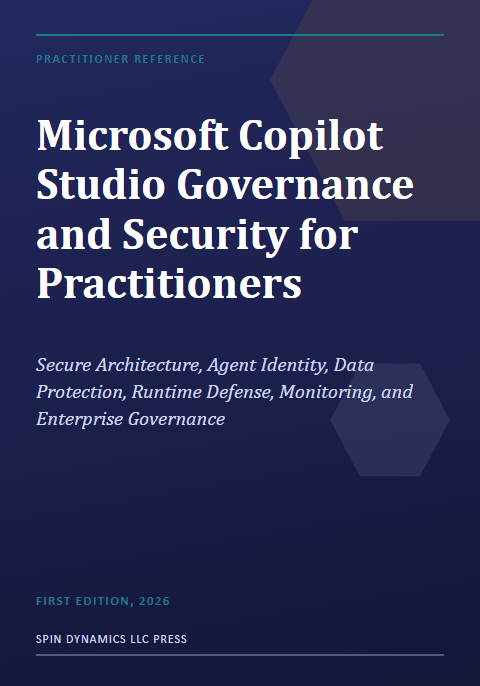
Cover of Microsoft Copilot Studio Governance and Security for Practitioners

Microsoft Copilot Studio Governance and Security for Practitioners

Secure Architecture, Agent Identity, Data Protection, Runtime Defense, Monitoring, and Enterprise Governance

Practitioner referenceComing soon

Copilot Studio lets a business analyst assemble, in an afternoon, a system that reads enterprise documents, reasons over untrusted text, and acts on enterprise systems with someone's credentials. This book moves the security question from "what can the model say?" to "what authority does the agent hold?" and answers it with the Agent Authority Security Model: identity, knowledge, tools, permissions, autonomy, actions, impact, and evidence.

Fifteen chapters cover environment governance and secure application lifecycle management, agent identity and authorization, knowledge and data loss prevention, tools, connectors and MCP, prompt injection and agent manipulation, excessive agency, runtime protection, monitoring and detection, incident response, enterprise governance at scale, government and regulated deployments, and reference architectures. Each chapter ends with a reusable artifact, and the appendices add an engineering checklist, a threat-modeling worksheet, a security test catalog, a framework crosswalk, and a Microsoft Learn source map. The book is an independent publication, not affiliated with or endorsed by Microsoft.

Course track
Microsoft Copilot Studio Governance and Security

Written for

  • AI engineers and Copilot Studio makers who need agents that pass security review the first time.
  • AI security engineers, red teamers, cloud and enterprise security architects, Power Platform administrators, and Microsoft 365 and identity engineers.
  • SOC and detection engineers, GRC and AI governance teams, and federal and regulated-industry architects who cannot assume commercial-cloud feature parity.

All rights reserved. Published by Spin Dynamics LLC Press.